The Third Decade (1992-2002)
In 1992, the Goods and Services Tax came into effect in Canada, and at the OUAC, many new ventures came to fruition as the OUAC entered its 20th admissions cycle. The Toronto Blue Jays won back-to-back World Series, and the OUAC developed a logo.
In the 1995 Quebec referendum, citizens against a separation just barely won. At the same time, a review of the University Information Program (UIP) took place, questioning whether the program was still effective. The resulting fate was the same as Quebec's - the former would remain a part of the OUAC and the latter would remain a part of Canada. In 1997, the CTV News Channel began broadcasting; the same year the Ontario Universities' Fair was founded.

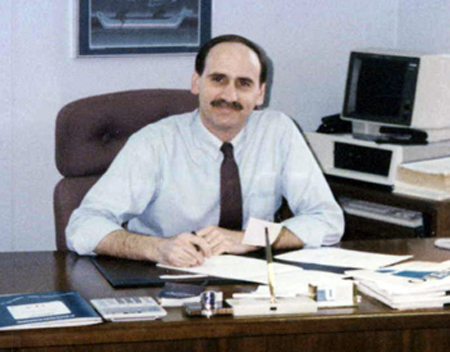
Gregory (“Greg”) Marcotte (Executive Director, 1989-2003)
Greg was appointed Executive Director of the OUAC on March 29, 1989. Prior to his time at the OUAC, Greg had worked in admissions since 1983, serving as Director of Admissions and Associate Registrar at the University of Ottawa, and Registrar and Secretary of Senate at Bishop's University in Lennoxville, Quebec.
During his tenure at the OUAC, Greg spearheaded many great successes. He took a leading role in promoting the OUAC and making it much more visible, both domestically and internationally, which included differentiating the OUAC with a distinctive logo. He was also the first bilingual director at the OUAC and helped mandate French service, which resulted in the OUAC becoming a fully bilingual organization.
Greg is a graduate of Western University where he majored in Sociology. In 2003, Greg went on to serve as Director of Registrarial Services at the University of Windsor where he stayed until his retirement in 2012.

Staff
OUAC staff continued to grow throughout the third decade with the addition of middle management, and a publications coordinator and in-house translator (English/French). But the growing number of employees didn't deter from the small family atmosphere. Any excuse for food and fun was welcomed. An annual luncheon was held in June as a thank you to part-time staff after they finished work for the year. The large volume of data input could not be completed without the assistance of part-time staff.
The OUAC has always participated in fundraising efforts, including raising funds for the United Way through proceeds from chips and chocolate bar sales at the office. Since the OUAC was located far from corner stores, sales of such items have always been brisk.
The 1990s also saw the advent of celebrations and friendly competitions between the OUAC, the COU extended family and OCAS friends.

- In 1993, the OUAC obtained its first file servers - Novell Netware and OS/2 server.
- Over the course of a weekend in 1995, the OUAC's system was converted from AS/400 to 64-bit computing. This was also the year that the OUAC obtained its First Unix server and the OUAC website went live. The OUAC was the second organization in Guelph to have its own website (after the University of Guelph).
- Through the efforts of OURA, the Ontario universities developed a system whereby academic transcripts were exchanged electronically using Electronic Data Interchange (EDI) and the SPEEDE/ExPRESS standard - the Ontario Universities' Electronic Transcript System (OUETS). The OUAC was asked to house and administer the OUETS on behalf of the universities. This also included a partnership with the Ontario colleges through a trading hub operated by OCAS.
- In 1997, the OUAC's Referral Service went live on the web and became the first in-house web-based tool.
- The 105F web application for all other undergraduate applicants went live in 1998 with the 105D web application following in 1999.
- In 1999, the OUETS won the Postsecondary Electronic Standards Council "Best Practices Award".
- In 2000, the TEAS online application went live with OMSAS following in 2001. The latter was the first high volume application at the OUAC.
- In 2001, the OUAC began to prepare for the upcoming double cohort year with a pilot among a handful of school boards across Ontario.
- In 2002, the OLSAS web application went live and the Ontario Secondary School Application went live for the double cohort – both with success!

In 2001, over the Easter weekend, the OUAC moved to a new 25,000 square foot building at 170 Research Lane. The OUAC celebrated its Grand Opening on May 25, 2001.
Those who have been to a meeting at the OUAC have likely heard the names of the OUAC's various meeting rooms, each named after a prominent person in the OUAC's history:
- Pettipiere Room - Named after Herbert W. Pettipiere, Founding Director 1971-1989.
- Arthurs Room - Named after Gerry Arthurs, Founding Assistant Director 1971-1987.
- Riley Room - Named after Richard Riley, Manager of Data Systems 1971-1993.
- Ron Scriver Conference Room - Named after Ronald W. Scriver, Director of Operations 1988-2005.
Unofficially, one corridor in the Research Lane OUAC building used to be called "Programmer Alley" as that's where all of the development staff was located.

- In 1992, an INFO Editorial Board (IEB) was formed to help guide the ongoing development of INFO Magazine and determine its content.
- For the 1992-1993 admissions cycle, the base application fee increased to $50, representing the OUAC's new mandate to be a partial cost recovery agent for the universities.
- As a result of the 1995 review of the University Information Program (UIP), OURA established the Ontario Universities' Fair (OUF) in 1997 as a tool to help secondary school students gather information about universities in Ontario.
- The first admissions cycle for the Ontario Law School Application Service (OLSAS) took place in 1997.
- In 2000, the Ontario Rehabilitation Sciences Programs Application Service (ORPAS) began providing application processing services for applicants to the Ontario schools of rehabilitation sciences.

The OUAC logo
In 1992, the Ontario colleges opened their own application service in Guelph, called the Ontario College Application Service (OCAS). Shortly after OCAS' arrival, Guelph postal services began confusing OCAS with the OUAC and both operations began receiving large quantities of one another's mail, which is why Greg determined that a distinctive logo be placed on all OUAC printed materials to reduce post office confusion.Four logo concepts were created for the OUAC.
The logo that was chosen continues to be used today.
In addition to differentiating the OUAC from OCAS, the OUAC logo also represents:
- the processing and movement of information in an interactive manner;
- free and open space;
- a path (e.g., to higher education);
- a synthesis of ideas and information;
- open exchange of ideas and information;
- having a capacity for adaptive change;
- service;
- flowing knowledge;
- open communication channels;
- receiving and sending;
- individual movement;
- teamwork; and
- the circle represents the collective Ontario university system.
The OUAC staff (1994)
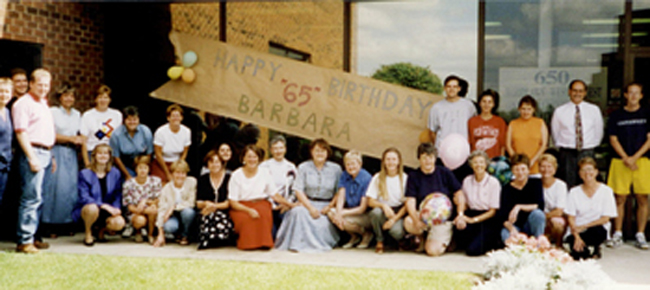
Celebrating Barbara Cottrell's 65th birthday
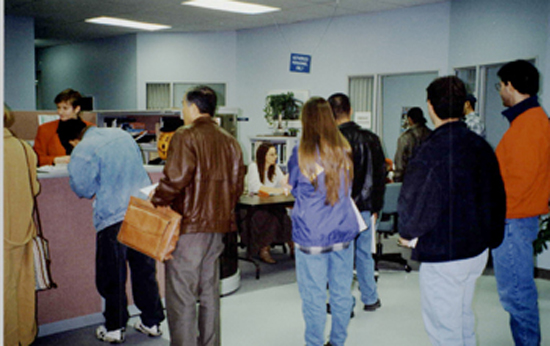
OLSAS and OMSAS
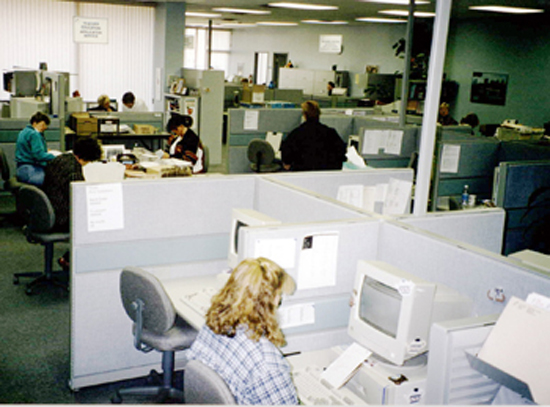
The old workspace at 650 Woodlawn Road
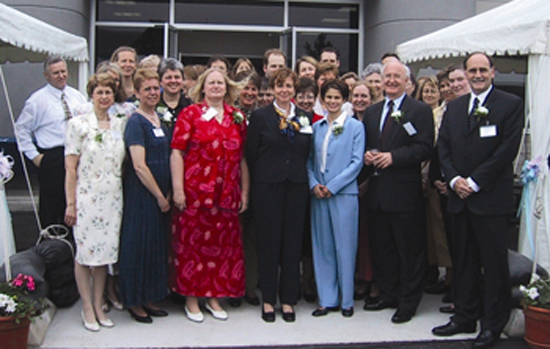
Grand opening at Research Lane (2001)
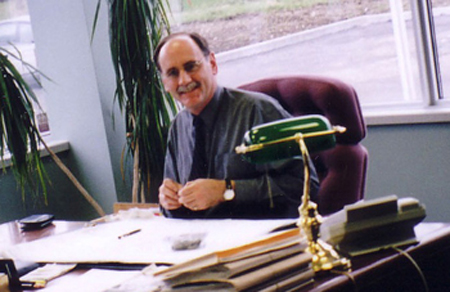
Greg Marcotte
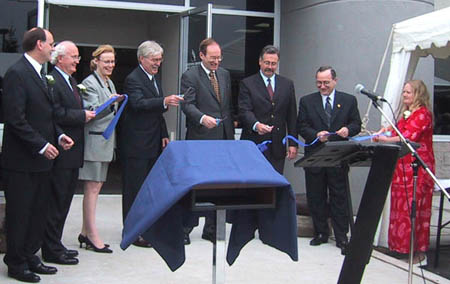
Ribbon cutting ceremony at Research Lane (2001)
45 Facts
You May Not Know About the OUAC
- In 1997, when the OUAC began to process Law School applications, 11,961 were submitted.
- The first two-day Ontario Universities' Fair (OUF) was held September 13-14, 1997 at the Metro Toronto Convention Centre with an estimated attendance of 30,000 people. The OUF has since grown to host more than 130,000 students, parents and educators each fall.
- When Rehabilitation Sciences joined the OUAC's application process in 2000, 2,367 applications were submitted.
- In 1999, the OUAC's submission, "Ontario Universities' Electronic Transcript System (OUETS): A Model of an Electronic Standardization Initiative," won the Postsecondary Electronic Standards Council's (PESC) Best Practices Competition - an internationally recognized prize in the area of electronic standards initiatives.
- In 1999, the OUAC Safety Committee was born after a delivery person was injured on the premises.
- In anticipation of the OMSAS deadline in 2001, the OUAC's internet bandwidth was increased fourfold. Despite this increase, there were so many applicants using the online application that the system became congested. The OUAC's bandwidth was increased another threefold as a result.
