The First Decade (1972-1982)
During the 1972-1973 admissions cycle, while Montreal was already beginning to prepare for the 1976 Summer Olympics, the OUAC became fully operative for the admission of applicants to full-time first-year university programs to Ontario universities...

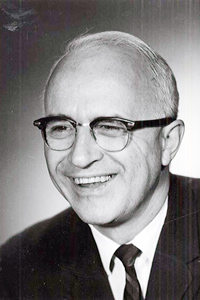
Herbert (“Herb”) Pettipiere (Founding Executive Director, 1971-1989)
In 1949, Herb spent six months with Canada Packers doing cost of efficiency studies - his first industry job after receiving his Bachelor of Science in Agriculture degree.
He then went to the Ontario Agricultural College (OAC) where he held the position of Assistant Dean of Men, and later, the Dean of Men.
By 1956, Herb became Registrar of the OAC. Six years later, Herb assumed the same position with the Federated Colleges, and by 1966, filled a dual role as registrar and senate secretary.
From 1956 to 1962 as OAC registrar, Herb updated office administration and converted academic records to data processing, making the OAC the first institution of its kind in Ontario to make the move to computers.
In 1964, Herb became registrar and secretary of senate for the newly developed University of Guelph and worked directly with the university president in planning and development.
When not in meetings or coordinating duties, Herb found time to relax with his wife and their three children, particularly at the family's cottage.
In 1971, Herb left the University of Guelph to help found the Ontario Universities' Application Centre, where he remained until he retired in 1989.
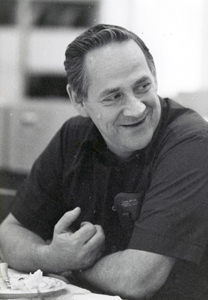
Gerry Arthurs (Founding Assistant Director, 1971-1987)
While Herb was the Registrar at the University of Guelph, he hired Gerry. It is said that the two immediately got along. While Gerry worked in the Registrar's Office he developed their first computer system. In 1971, Gerry followed Herb to the OUAC where he worked as the Assistance Director until his retirement in 1987. During his tenure, Gerry also set-up the OUAC's first computer system and is said to have been very personable with the OUAC staff.
Gerry was a skilled engineer with a wife, Louise, and two children, Kathy and Steve. When he wasn't busy pioneering computer systems at work, Gerry and his family spent time at their cottage in Bala.
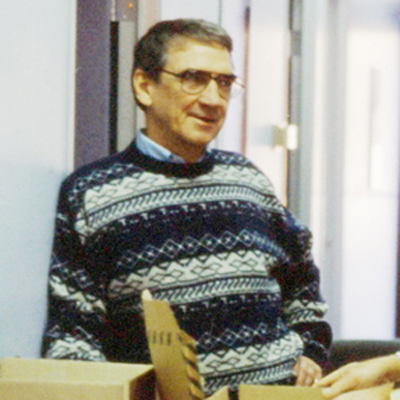
Richard (“Dick”) Riley (Manager of Data Systems, 1971-1993)
Dick joined the OUAC in 1971 where he continued to work for 22 years until his retirement. During his time at the OUAC, Dick held the position of Senior Systems Analyst and then Manager of Data Systems, and designed the OUAC's undergraduate, medical and teacher education application systems, as well as the OUAC's in-house accounting system.
Dick was also involved in the Association of Canadian Medical Colleges (ACMC) and attended meetings of the Medical Admissions Committee of the Council of Ontario Faculties of Medicine (MAC-COFM). Dick graduated from the University of Toronto with an Honours Bachelor of Applied Science and Civil Engineering degree, which he put to use with many projects. He was especially proud of his work on the Bay Street off-ramp from the Gardiner Expressway. He ensured his passengers were aware of his work during trips to the COU office.
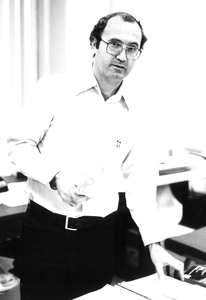
Ronald (“Ron”) Scriver (Director of Operations, 1988-2005)
Ron joined the OUAC in 1973 where he continued to work for 32 years. During his time at the OUAC, Ron was a respected leader, known as the "real nice guy who always gets the job done as promised". Ron had a great sense of humour and was often involved in practical jokes around the office.
On the professional side, Ron helped develop the Electronic Data Interchange (EDI) process and the early online application process. What he is most remembered for, however, is his close relationship with OUAC staff members and his effortless ability to motivate and inspire. Ron was a graduate of the University of Guelph where he received a Bachelor degree in Computer Science.
Ron passed away in 2005, after which a bursary was created in his name at his alma mater. The scholarship fund continues to grow steadily.
Staff
In the beginning, the number of full-time OUAC staff could practically be counted on one hand. There were about 10 to 15 full-time employees in 1972 and a handful of part-time employees.

Student applications that were processed at the OUAC during the first decade consisted of five sheets of paper, each separated by carbon paper. Three copies were sent to the universities indicating the student's choices, one went to the student's high school (or was kept by the student), and one remained at the OUAC.
If legible, the carbon-copy applications were forwarded to the universities identified by the student. According to Herb, "by the time you got to the second or third carbon copy, more than 30 percent of them were beyond deciphering and had to be photocopied."
- In the 1970s, the OUAC did not have its own computer mainframe so staff utilized the one at the University of Guelph.
- The OUAC employed two in-house programmers who programmed in Mark IV programming language and utilized punch cards until the early 1980s.

For the first few months of its operation, the OUAC was housed at the COU offices in Toronto. Shortly after, the organization moved to a 1,000 square foot space quietly "hidden" in the Omark Canada (now Blount Canada) manufacturing plant in Guelph as it didn't need to be accessible to the public.
"There is not one university student in this province that has not heard of Guelph," Herb said in a 1982 newspaper article. And that's because the city's name was printed across the top of all university application forms.
In addition to being a convenient and central location (not just physically to Herb's house!), the OUAC's first location was also less expensive to operate than it would have been if the office been located in its own space in Toronto, as was the original plan.

- Applicants from 1971-1973 paid a $4 application fee, which in combination with a grant of $65,000 from COU, and a seed grant of $150,000 from the Ontario government, funded the start up of the OUAC's operations. Since then, OUAC operations have been funded entirely by application fees.
- The OUAC is registered as a not-for-profit charitable agency, operating under the auspices of the COU. The activities of the OUAC are monitored by an Advisory Board, which includes representatives from all of the OUAC's user groups.
- The first admissions cycle for the Ontario Medical School Application Service (OMSAS) took place in 1975.
- The first admissions cycle for the Ontario Teacher Education Application Service (TEAS) took place in 1979.
Herb Pettipiere
Gerry Arthurs
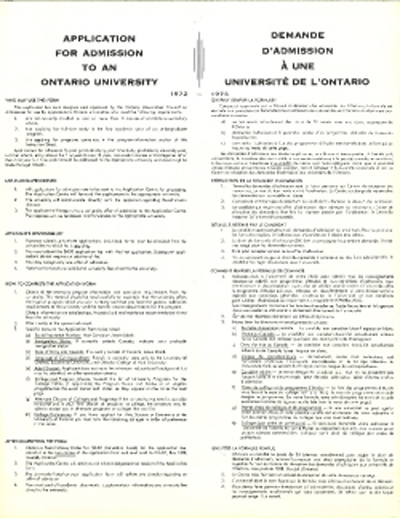
The original 105 undergraduate application (1972-1973)
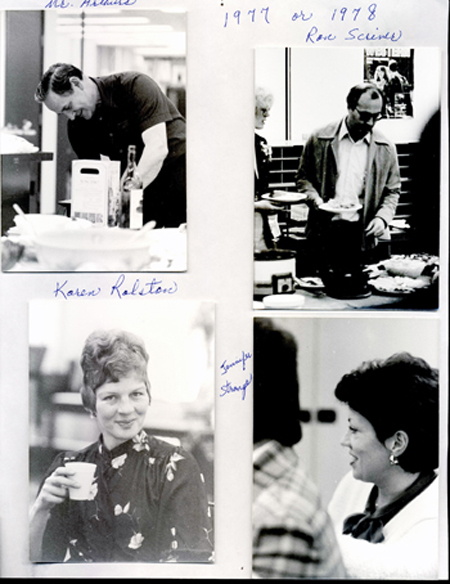
1970s OUAC employees
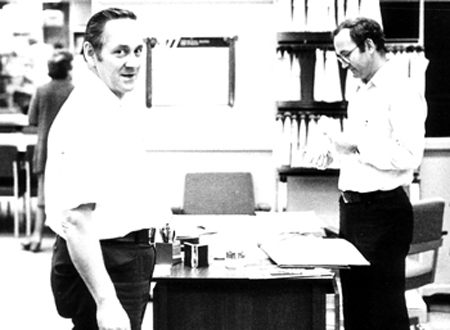
Gerry and Ron
Ron Scriver
Dick Riley
45 Facts
You May Not Know About the OUAC
- The 101 and 105 division/application names were based on the form numbers assigned by the printing company to the original printed application forms.
- The OUAC's total operating cost for 1971-1972 was $325,450, $124,000 of which contributed to company salaries and benefits. By 2011, OUAC operations and fund balance requirements cost approximately $10 million.
- Allegedly, the address for the OUAC's first official location - at the former Omark Canada building - is so hard to find because Herb Pettipiere didn't want the address to be known to students; mail was sent to a P.O. Box.
- 135,361 undergraduate applications were processed during the OUAC's first operating year.
- In the beginning, the undergraduate application fee was just $4. When OMSAS joined, application fees were $10. TEAS applications were $7 when they first began.
- In 1972, the Communication "Division's" tasks consisted of sending information to Ontario secondary schools in the form of a poster that said: "Applying for Admission to an Ontario University?" and an outline of the application procedure.
- According to the OUAC's 1972-1973 operational procedures manual, the OUAC's list of documents consisted of a whopping eight forms to be filled out by Grade 13 students.
- In its annual brief to the provincial committee on university affairs in 1973, one particular university said that "the Centre serves no useful purpose." It later conceded that point.
- In 1975, the first year the OUAC processed OMSAS applications, there were 11,006 applications.
- In 1979, the first year for TEAS applications, there were 11,855 applications.
- In 1982, the bulk of applications from Grade 13 students indicated a renewed interest in the sciences, engineering, and job-oriented university programs.
